It’s been years since I’ve posted here. A lot has changed in my life. I’m happily married and have a beautiful daughter who brings so much joy to us. Alhamdullilah.
I’ve moved to a different state in the U.S. It’s been a new experience, for sure. I’m reactivating this blog because I’ve realized that there are many posts on here that people still benefit from. I wanted to make them accessible in case people found them helpful.
I realized that I never gave a formal farewell. I’m grateful for all of the readers I’ve had since I started this blog (which I think was in 2009)! Something I never wanted to take for granted was the support and feedback I received from people on this blog, especially the regular readers. I truly appreciate everyone who found value in anything I had to share here. There were times when I used blogging as an outlet to cope with Islamophobia and racism in my life. It meant a lot to hear from you all and your support made a difference. Thank you.
I’m still blogging from time to time, but on different blogs and platforms. If you’re interested in reading some of my latest posts, just leave a comment here with your e-mail address, and I’ll send you links. I don’t blog nearly as often as I did before, so just FYI.
If you choose to comment on this blog, just be aware that it will most likely not be posted (with the exception of this post, of course). Once I figure out how to close comments on my old posts, I will do so. Again, I’m really just reopening this for people to access my older work.
I cannot thank you all enough. I hope and pray that we have a better year ahead of us in 2021.
Beautiful rendition of an Afghan folk song, “Khuda Bowad Yaret,” sung by Azam Ali of Niyaz. Farsi lyrics and English translation are below (via this site).
(Farsi)
Khudâ buwad yârat qur’ân nigahdârat
sakhi madadgârat sakhi madadgârat
alâ yâr jân khatar dârad judâyi
nihâli besamar dârad judâyi
biyâ ki mâ wu tu yak jâ bishinem
ki margi bekhabar dârad judâyi
khudâ buwad yârat qur’ân nigahdârat
sakhi madadgârat sakhi madadgârat
dili man zin hama ghamhâ fasurda
tawânam râ ghami ishqi tu burda
darigha ruze âyi bar sari man
chiraghi umri man bini ki murda
khudâ buwad yârat qur’ân nigahdârat
sakhi madadgârat sakhi madadgârat
biyâyi didanam tarsam ki ân ruz
ba ghair az sabzayi khâkam nabini
khudâ buwad yârat qur’ân nigahdârat
sakhi madadgârat sakhi madadgârat
(English translation)
Khuda (Allah/God) be with you,
Quran (Holy Quran) be your protector,
Sakhi (Soubriquet of Hazrat Ali, son-in-law of Prophet Mohammad) be your helper.
My very dear person parting is very dangerous,
It is like a plant without fruit,
Let’s sit together,
Because parting has an unknown dead.
Khuda (Allah/God) be with you,
Quran (Holy Quran) be your protector,
Sakhi (Soubriquet of Hazrat Ali, son-in-law of Prophet Mohammad) be your helper
My heart is overwhelmed with sorrows
Your love’s sorrow consumed my strength
Unfortunately, if you came to my bedside
You see that my life has ended
Khuda (Allah/God) be with you,
Quran (Holy Quran) be your protector,
Sakhi (Soubriquet of Hazrat Ali, son-in-law of Prophet Mohammad) be your helper
When you come to me someday,
Won’t see even other than grass on my soil
Khuda (Allah/God) be with you,
Quran (Holy Quran) be your protector,
Sakhi (Soubriquet of Hazrat Ali, son-in-law of Prophet Mohammad) be your helper
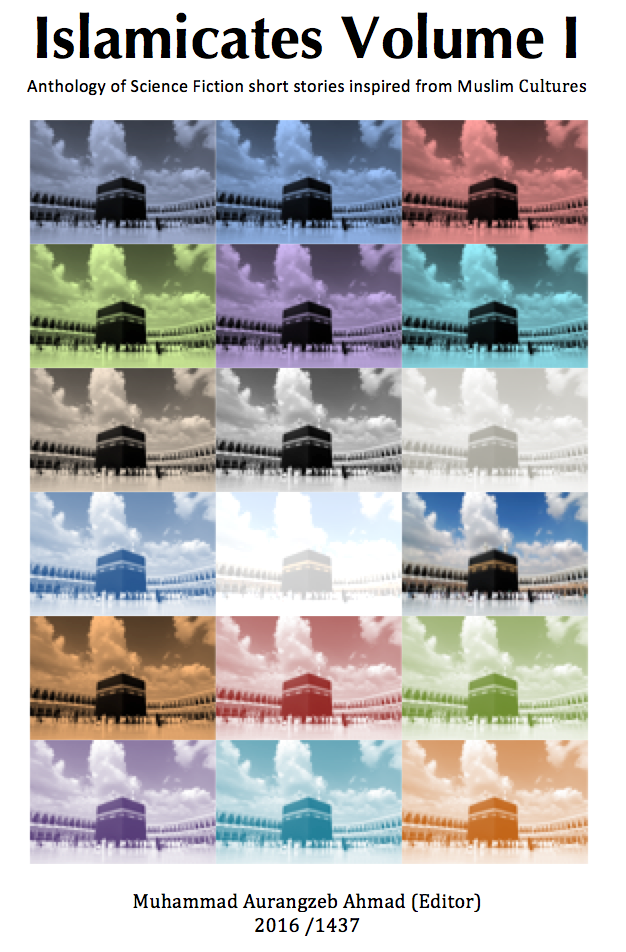
I know it’s been a while since I’ve updated my blog. I’ve been meaning to share this, but kept putting it off due to other commitments. Back in August, a really awesome anthology of science fiction short stories was put together by Muhammad Aurangzeb Ahmad over at Islam and Science Fiction. As described on the site, the anthology is “centered around Science Fiction with Muslim characters or Islamic cultures.” The term “Islamicate” refers to the “cultural output of predominantly Islamic culture or polity” and is “similar to the term West as it encompasses a whole range of cultures, ethnicities and schools of thought with shared historical experience.”
The anthology contains a total of 12 short stories, one of which was written by me. I felt like I could have expanded on my story if I gave myself more time to write it, but I’m glad to be part of an anthology like this. Something I always appreciated about science fiction is how it is often filled with social and political commentary, and I thought it was important for me to directly address Islamophobia in my short story. While most of my creative energy has been focused on my independent feature film, it was nice to revisit my passion for writing short stories, especially science fiction. It’s also exciting that the anthology was featured on i09,Tor.com,and The Arab Weekly!
You can read and download the complete anthology by following this link. Insha’Allah I’ll return soon with more blog posts!
[Image description: a pair of hands hold a yellow poster board that reads “Islamophobia is Racism” in bold black ink.]True Lies, Executive Decision, Not Without My Daughter, The Delta Force, Rules of Engagement, The Siege. These are just some of many Islamophobic Hollywood films produced before the attacks on September 11th, 2001. In fact, Jack Shaheen documented over 900 films in his book Reel Bad Arabs,which examined how U.S. cinema demonized Arabs for about 100 years. The book was originally published in July of 2001, 2 months before September 11th (it was adapted into a documentary in 2006). Although Shaheen’s research focused on media depictions of Arabs, he does note the way “Arab” gets conflated with “Muslim,” and vice versa. In his other critiques, particularly of Arabs in mainstream American comic books, he also mentions how Iranians, Muslims, and Arabs get treated as “one and the same.”
I did not want to write about 9/11 this year because of the way it is marked, particularly how everyone is expected to share their stories about where they were, what they felt, what grade they were in, whether they were on their way to work, etc. Over the years, where we have seen the bombings of Muslim-majority countries and racist attacks on other communities of color, there is never a universal call for commemoration or a moment of silence for people of color victimized by white supremacist terror. We are not taught to mark the dates of brutal atrocities against Afghans, Iraqis, Palestinians, Pakistanis, Yemenis, Somalis, Syrians, and other people of color. We are not told to hold annual memorials for racist murders and violence against Black people, Indigenous people, women of color, queer and trans people of color, and so on. We are not expected to know their names nor their stories. Instead, the state demands that we remember the lives lost on 9/11, not for the sake of these individuals and their families, but because the “threat of Islam” should remind the masses that the U.S. must continue its violence against Muslims and people of color everywhere in the name of “freedom” and “security.”
Last year, during the 14th anniversary of the attacks, I could not help but notice thearticles about post-9/11 experiences that Muslims, Sikhs, South Asians, Arabs, Iranians, and others were sharing. I understood the use of the hashtag #AfterSeptember11 because I am aware of the heightened increase in discriminatory acts, hate crimes, vandalism, profiling, and detainment that many Muslims and those perceived to be Muslim experienced. The stories are powerful, heartbreaking, upsetting, and important, especially since Muslims are rarely, if ever, given a platform to share them in mainstream media. In the past, I have written about my experiences with racism and Islamophobia as well, but something I always realize in my reflections is that I, like many Muslims, encountered Islamophobia prior to 9/11, too.
The purpose of this piece is not to dismiss the post-9/11 stories at all, but rather emphasize an important point about how Islamophobia existed long before 9/11. Many commentaries I have read, written by both non-Muslims and Muslims alike, set September 11th as the start date of Islamophobia in the west (some even problematically label Osama bin Laden the “father of American Islamophobia”). We need to resist this narrative for its inaccuracy, but also because it reinforces violent erasure of both the past and the present — especially of Indigenous and Black peoples, including Black Muslims. Furthermore, the narrative reinforces the notion that Muslims “caused” Islamophobia.
Tracing the origins of Islamophobia is beyond my area of expertise, but we know bigotry and hostility against Muslims began as early as the advent of Islam. In 7th century Makkah, Islam challenged many traditional practices of the Quraish, the dominant tribe at the time. Like all movements against social injustice, the oppressors treated Prophet Muhammad (peace be upon him) and the early Muslims as disruptive and threatening to the status quo. The call to abolish female infanticide (Qur’an, 16:58-59), for example, represents one of many examples of how it is impossible to separate Islam from its advocacy for social justice. Resisting oppression (4:75), respecting and honoring human diversity (30:22), building alliances with other communities (49:13), and standing out firmly for justice (4:135) are all integral to Islam’s spiritual message. The early Muslims faced adversity, persecution, and dispossession at the hands of the Quraish. Many Muslims were tortured and often killed by the Quraish for converting to Islam.
In her book, Muslims in the Western Imagination, Sophia Rose Arjana proposes the question:”How did we get here?” That is, how did we get to this place and time when we see Islamophobic sentiments, practices, and policies in the west? Arjana argues that these realities are “not simply a result of September 11, 2001, Madrid 2004, or London 2005, nor a culmination of events of the past decade or the past century.” While acknowledging the increased visibility of Islam and Muslims following these incidents, as well as U.S. invasions of Afghanistan and Iraq, Arjana points out:
“[T]hese concerns represent old anxieties that lie within a multiplicity of times and spaces on the pages of manuscripts and canvases of paintings, in works of great drama, poetry, and fiction, within travel diaries and government documents, and on the screens of movie theaters. To find the answer to the question posed here, we must look at numerous fields of cultural production; there, we find a vision of Islam that is both familiar and unsettling. Within it, we must seek what is common. What is common is the Muslim monster.”
For medieval Christian writers and poets, Prophet Muhammad was viewed as a “heretic,” “inspired by the devil,” and even the “Anti-Christ.” Chapati Mystery has an excellent article that provides a detailed historical overview of western depictions of the Prophet. The author writes:
“The earliest Christian polemics saw Muhammad as a corruption, and as an imposter who was taking on the crown of Christ. . . . The histories of Crusades written in the twelfth centuries – such as the Gesta Dei per Francos – cast ‘Mathomus’ as an epileptic who was inspired by the devil to corrupt Christians. The effort to portray a bumbler, foamer-at-the-mouth, a charlatan is a theme in many of these narratives.”
In later medieval writings, the article mentions Muhammad portrayed as “frequently ‘wicked,’ ‘with a desparate stomach,’ and delighted with rapes and plunder, or was seducer of women, of mongrel birth, and whose name tallied up to 666.” In the 14th century classic, the Divine Comedy, Italian poet Dante Alighieri placed Prophet Muhammad and Imam Ali in the 8th circle of Hell, condemning them to vicious torment for being “sowers of religious divisiveness.“
The article also highlights on racialized and demonizing commentary about the Prophet appearing in the first English translation of the Qur’an in 1649. In the text’s introduction, as the author points out, Muhammad is described as “the great Arabian imposter” who arrived in England “by way of France.” He is compared to an “African monster” for “people to gaze at, not to dote upon.” This likening of the Prophet to an “African monster” is significant as it reflected medieval Europe’s view of black skin symbolizing the devil, demons, and monsters. Arjana’s aforementioned book delves into the long history of Muslims being constructed as monsters, a “recurring theme” that was “first formulated in medieval Christian thought.” Examining medieval writings as early as the 5th century, she writes:
“Dark skin was understood as a theological consequence of sin. Gregory the Great claimed that Ethiopia was a sign of the fall of mankind, and other Christian writers followed suit, tying dark skin to sin and perdition. Jeremiah surmised that the Ethiopian’s skin could change like a leopard—one of many examples in which Africans were likened to animals. Muslims were often depicted with black, blue, or purple skin. Muslims reportedly worshipped Venus, a black goddess ‘dressed in a gold robe with a striking red blob for its hellish tongue.’ Islam has, from the beginning, been an identity situated in racial, ethnic, and cultural difference.”
Western Europe referred to Muslims as “Saracens,” who were “described as Muhammad’s progeny” and seen as a “monstrous race that spawned a number of creatures, including one of the more popular characters of the medieval Christian imagination — the Black Saracen.” According to Arjana, medieval paintings and depictions of the Black Saracen was an amalgamation of three entities: Saracen, Jew, and African — a “hybrid monster.” She also notes that while Saracen “initially referred only to Arabs, it was soon applied to Muslims, Ethiopians, and Jews.” Furthermore, the terms “Saracens,” “Turks” and “Moors” were used interchangeably, often conflated to describe the “Muslim enemy.”
It is important to note that “Moor” was a term many Europeans applied to Africans since ancient times, not just in post-Islamic times. Contrary to popular belief, “Moor” does not mean “Muslim;” it was a word used by Europeans to describe black-skinned people. The origin of “Moor” is from the Greek word “μαυρο” or “mavro“ which means “black, blackened, or charred.” When North African Muslims (predominately Berber), led by Tariq ibn Ziyad, invaded Visigothic Hispania in 711, Europeans used the term “Moor” to refer to Muslims in Spain and North Africa. Like the present, Muslims were made up of diverse racial and ethnic groups, and after the 8th century, according to Dana Marniche, use of “Moor” began to include many Arabs “who had invaded the Mediterranean and Africa because of their complexions which were the same dark brown or near black to absolutely black color of the Berbers.” What we see in European demonization of Africans and black skin is obvious anti-blackness, and in their conflation of diverse ethnic Muslim groups, we see racialization of Islam and Muslims, which persists today (as I wrote in my post, “Debunking the ‘Islam is Not a Race’ Argument”).
As one can imagine, demonization of Islam and Muslims was pervasive throughout the Middle Ages, especially during the Crusades. The Crusades: A Reader provides a comprehensive collection of documents and speeches from both Muslim and Western Christian sources. Prior to the First Crusade in 1096, the Byzantine emperor Alexius I needed assistance to defend against Turkish forces near Constantinople, so he wrote to Pope Urban II. The latter was so tired of Christians fighting and killing other Christians in civil wars that he saw this as the perfect opportunity for Christians to unite and channel their hatred towards the Muslims. More important than helping defend Constantinople, what appealed to Pope Urban II the most was the prize of Jerusalem in the East — if Christian armies could capture Jerusalem, he would be remembered throughout history as the man who drove out the “infidels” and “rescued” the Holy Land.
During his sermon at a church council in Clermont, France, Pope Urban II declared that taking up arms against “the vile race” (Muslims) was “commanded by Christ.” He promised direct salvation; anyone who participated or fought in the Crusades would have their sins remitted instantly and granted entrance to Heaven. In addition to spiritual rewards, there were promises of treasures and wealth in “the land of milk of honey.” According to numerous accounts of his speech, Muslims were described as “barbarians,” “infidels,” and an “accursed and foreign race” that “worships demons.” Unsurprisingly, the Pope used strong religious language to justify war and also exaggerated about the mistreatment Christians experienced under Muslim rulers. For instance, he stated: “They (Muslims) circumcise the Christians and pour the blood from their circumcision on the altars or in the baptismal fonts. . . . It is better to say nothing of their horrible treatment of the women.” The depiction of Muslims as “barbaric” and the focus on Muslim men’s “horrible treatment” of women can still be found in the language and narratives used today to launch wars against Muslims. This is not to deny real issues regarding misogyny in Muslim communities, but rather to challenge western political narratives that exploit the struggles of Muslim women to justify bombings and invasions of Muslim-majority countries. The West’s hypocrisy on sexual violence is no different than how Crusader knights would rape women (whether they be Muslim, Jewish, or Christian women) and never be held accountable while pointing fingers at Muslim men as the “real” perpetrators of sexual violence.
Casting Muslims as “infidels,” “demons,” and “evil” is something we still see today. U.S. president Barack Obama, hardly an ally to Muslims, is thought to be Muslim by nearly a third of Americans, including 43% of Republicans. Many extremist white Christians have been explicit in stating that both Muslims and Obama are “of the devil,” a belief reflecting an old, though prevalent, Western/European tradition of demonizing Muslims and Black people. In The History Channel’s miniseries, The Bible, where Jesus (peace be upon him) and his disciples are portrayed by white men, Satan was not only depicted as a dark-skinned man, but many also claimed there was a striking resemblance to Barack Obama. Criticism led to producers eventually cutting the scenes, but whether or not the resemblance to Obama was intentional, the main issue remained: the devil is depicted as a Black man. It can be argued that given the history of linking Muslims with blackness and blackness with evil, present-day demonization of Islam and images of a Black male devil represent Western anxieties of the Black Saracen mentioned in Arjana’s research. Moreover, this demonization goes beyond hatred of Obama specifically and reflects the reality of white supremacist attitudes, violence, and laws that target Black people (both Muslim and non-Muslim).
As we continue to examine history, we see more examples of military offenses against Muslim-majority regions. The Catholic reconquest of Spain — the Reconquista — was a long and violent Crusade over a period of 770 years that sought to expel Muslims from Europe. In 1492, Catholic forces led by King Ferdinand II and Queen Isabella were successful in defeating the last Muslim stronghold in Granada. As a result, Muslims and Jews were forced to convert or leave their homeland. As we know, 1492 was also the same year Ferdinand and Isabella sponsored Christopher Columbus’ expedition to the so-called “New World,” as it fueled their interest in expanding European Christian domination.
The brutal European colonial expansion and conquest of Indigenous peoples and lands in North and South America and the Caribbean islands led to colonizers demanding the labor of enslaved Africans. According to Muna Mire, about 10-15% of the Africans forced into slavery were Muslim (other sources estimate up to 30% of enslaved Africans were Muslim). As Mire writes in her important article, “Towards a Black Muslim Ontology of Resistance”:
The first Muslims in America were Black. They were stolen from the western coast of Africa – modern-day Gambia, Nigeria, Senegal – and brought to the New World through violence. Some ten to fifteen percent of enslaved Africans brought to America as chattel practiced Islam as their faith when they landed on American shores. From the genesis of the American project, their labor – Black Muslim labor – would build the country from the ground up. But white Christian slaveowners did not tolerate these Africans practicing the religion they were born into. Enslaved Africans were converted to Christianity, wholesale, under threat of further violence. Like marriage, gatherings of Black people larger than three or four persons, or any other self-determined social custom, non-Christian religiosity was a threat to be eliminated amongst the enslaved. Black Muslim existence as Black resistance is as old as America itself.
History of Black Muslim resistance is erased in U.S. history textbooks, Muslim-American narratives, and discourse about Islamophobia. Instead, Islamophobia is treated as a post-9/11 phenomenon that primarily targets non-black Muslims. Mire emphasizes another critical fact: “Black Muslims existed prior to the colonial systems which brought them to the Americas, and they have been fighting assimilation for centuries. For a long time, to be Black has been to be Muslim.” Yet Black Muslim resistance against European conquest, slavery, forced conversion, white supremacy, police brutality, and assimilation are shamefully missing from dominant discourse about Islamophobia and Muslims in the U.S. As I have written before, anti-blackness among non-black Muslims and other people of color is a reality that cannot be ignored. In an interview with Al-Muslimoon Magazine in February, 1965, Malcolm X commented on how Muslims in Muslim-majority countries ignored the struggles Black Americans faced:
“Much to my dismay, until now, the Muslim world has seemed to ignore the problem of the Black American, and most Muslims who come here from the Muslim world have concentrated more effort in trying to convert white Americans than Black Americans.”
While I’m not an advocate of converting non-Muslims to Islam, Malcolm’s comment are important here because it reflects anti-black attitudes among non-black Muslims. Today, we may hear South Asian, Arab, and white Muslims speak proudly of Malcolm X, Muhammad Ali, and Hazrat Bilal, but still perpetuate anti-blackness in their communities. It is not uncommon to find non-black Muslims enthusiastically speaking about Islamic history and Muslim contributions to science, mathematics, and art, but resist acknowledging that many of these Muslims were also African. A color-blind “Islam does not see race” attitude continues to prevail in our communities, which works to further invisibilize Black Muslims, especially Black Muslim women. As Donna Auston stresses, this erasure “renders our communities even more vulnerable — to Islamophobia, to anti-black racism (including from within the Muslim community), and to all of the attendant perils that accompany them.”
What we have come to understand as Islamophobia today has primarily meant focus on the experiences of Arab and South Asian Muslim men. Marking September 11th, 2001 as the “starting point” of Islamophobia means erasing history of demonization, military campaigns, violence, and laws that have targeted diverse populations of Muslims around the world. The narrative also implies that the U.S. was not a hostile environment for people of color before 9/11, as it ignores genocide against Indigenous peoples, slavery of Africans, and institutionalized white supremacy. Sometimes I’ll read articles written by non-black Muslims who reinforce the mythical idea of a pre-9/11 “racial harmony.” This dangerously negates anti-racist, anti-sexist, anti-imperialist, and anti-colonial struggles that Black people, Indigenous people, and other people of color have fought and continue to fight.
What do we make of Israel’s violent dispossession of Palestine, Indian military occupation of Kashmir, U.S. imperialism in Muslim-majority countries, and the media’s demonization of Muslims if we believe Islamophobia did not begin until 9/11? What about the Islamophobic news coverage and bigotry that followed the Oklahoma City terrorist attack when Muslims were heavily blamed? In my personal experiences, as a Pakistani Muslim who grew up in a predominately white suburban town in the U.S., I recall my history teachers depicting Islam as a “backwards” religion. The Crusades was extremely romanticized, especially the figure of Richard the Lionheart, and our teacher made us believe Muslims started the wars and lost. In addition to brutally executing 3,000 captured Muslim prisoners, Richard the Lionheart never made it to Jerusalem, but was deemed the “hero of the Crusades.” In my high school social studies class, the teacher assigned everyone to do a presentation on terrorist organizations. All of the terrorist organizations we had to choose from were Arab and Muslim groups. When teaching the class about Islam, this same teacher showed us the anti-Muslim, anti-Iranian propaganda film, Not Without My Daughter. All of this happened before 9/11.
But Islamophobia goes beyond people saying or doing offensive and bigoted things to Muslims. Unfortunately, many liberals and western-based Muslim organizations treat Islamophobia as simply being about ignorance and individual acts of bigotry. I believe this is one of the major consequences of marking 9/11 as the origin of Islamophobia because the discourse places the blame of Islamophobia on the actions of other Muslims. In other words, the more we perpetuate the idea that Islamophobia began on 9/11, the less we understand Islamophobia within the larger context of white supremacy and historical hostility against Muslims and Islam. Not recognizing Islamophobia as institutionalized and state racism doesn’t just fail other Muslims, but also places us in opposition to building solidarity with other communities, especially Indigenous Peoples.
For instance, it is not hard to find articles filled with narratives about how non-black and non-indigenous Muslims claim the U.S. as their “homeland,” and how they are treated as “strangers in their own land.” Representatives of mainstream western-based Muslim organizations (that center on non-black Muslims) have often stated that Islamophobia is the “only form of acceptable racism left.” To disprove this absurd and, frankly, self-absorbed statement, one just needs to look at the countless examples of how racism against Black people, Indigenous peoples, Latino/as, East Asians, and other communities of color are still viewed as acceptable. Blackface in the media, films depicting “Yellow Peril” (including the recent film, No Escape), Native American sports mascots and Halloween “costumes,” assigning the dehumanizing term “illegal alien” to Latino/as and other immigrants are only a few examples of normalized and acceptable racism that exists. We still see white men, especially police officers, walk free after murdering Black and Indigenous peoples.
In response to narratives where non-black and non-indigenous Muslims refer to the U.S., Canada, and other settler states as their “own land,” we need to understand how we become complicit in perpetuating genocide and settler colonialism against Indigenous Peoples. As mentioned above, many non-black and non-indigenous Muslims in the U.S. expressed how they felt like “outsiders for the first time” in their “own country” after 9/11. Indeed, it is a frightening and dangerous reality that Muslims are treated as perpetual threats, subject to racial profiling and detainment, placed under surveillance, and face discrimination in their schools, workplaces, and neighborhoods. The purpose is not to negate any of these realities and experiences, but instead advocate that we resist narratives that assume we are the “only” community (i.e. non-black and non-indigenous Muslims) that faces racism. Instead, we should recognize that our struggles against racism and oppression are connected to the struggles of other marginalized communities. How many North American-based Muslim civil rights groups have stood in solidarity with the struggles of Indigenous people who have seen their land stolen from them for over 500 years? Why are so many “American Muslim” (and other western Muslim) groups so invested in assimilating Muslims into the very colonial systems that seek to exterminate Indigenous Peoples?In the recent and brilliant online editorial, “Critical Transnational Feminist Analysis of Settler Colonialism,” one of the editors, Shaista Patel, powerfully articulates the importance of ethically engaging with other communities and understanding how struggles are interconnected. She writes:
“For those of us who work with the question of violence against Indigenous, Black and other bodies of colour, we are required to pay attention to the fact that these violences are intimately connected across spaces and times… For some of us, the question of complicity here as people living on stolen land, requires that we look into our histories and that we pay attention to all bodies who continue to demand that we ethically engage with violences. Paying attention to such questions moves us across continents, from past into present and back into the past and so forth. It asks us to trace the contradictions of the Empire which places us as both victims of violence but also as perpetrators of violence.”
All of us are participants in maintaining the interlocking systems of oppression, but we can make more ethical, diligent, and compassionate efforts to be more conscious of our privileges, responsibilities, and complicities. Recognizing these intersections and contradictions (within and outside of ourselves) reminds us that our liberation cannot be dependent on oppressing the rights of others. In an earlier piece, “Defining Muslim Feminist Politics through Indigenous Solidarity Activism,” Patel describes how Muslim solidarity with Indigenous Peoples comes from “an understanding that some of our historical trajectories coincide.” She cites how genocide against Indigenous Peoples in the “New World” and “expulsion of the last Muslims in Spain” were taking place in the same year of 1492. Additionally, she states:
“These braided histories of foundational violence of the ‘New World’ and Spain’s repudiation of its internal Others are important to remember so that we don’t forget how our destinies in a white-supremacist global order are tied in very material ways. . . . The history and present of the U.S. as a strong white settler-colonial and imperial power needs to be taken into account when movements in support of Palestinians, Afghanis, Iraqis, and other Muslims here are mobilized.”
I cite and raise the points mentioned above because I believe they can help us understand the damage mainstream narratives about post-9/11 Islamophobia causes. We are not going to stop Islamophobia if we think the West “suddenly” and “abruptly” became Islamophobic after 9/11, as if no history of racism and anti-Muslim bigotry existed before. If we were to apply this logic to white Christians, we would be seeing institutionalized oppression against white Christians in the West as a response to all of the murders and crimes carried out by white people. Islamophobia needs to be recognized as being ingrained in state racism. Furthermore, as Patel asserts, we need to understand Islamophobia as encompassing anti-blackness, as well as white supremacy (including white Christian supremacy), heteropatriarchy, imperialism, colonialism, Orientalism, Zionism, and so on. To truly understand Islamophobia in all of its complexity and intersections, it requires us to look beyond 9/11 and closely examine history.
I’ll conclude with saying there is no denying that Islamophobia and demonization of Islam and Muslims intensified after 9/11. I am not against Muslims writing about their post 9/11 experiences either, especially when there are so many efforts to silence us. Let’s keep telling our stories; they are important and need to be heard. The point I’m emphasizing is that, when we tell our stories, we need to resist narratives that set 9/11 as the “starting point” of Islamophobia because such narratives make us complicit in reinforcing notions that the U.S. (and the West in general) was once “kind” to Muslims and people of color. It is true that some Muslims did not experience Islamophobia and racism before 9/11, but we must not establish this as a truth for all Muslims and people of color. Instead of treating anti-Muslim bigotry as a “new phenomenon,” we need to remember that it has existed for centuries. Understanding this reality and challenging the post-9/11 discourse about Islamophobia is critical not just for building alliances and solidarity with other communities, but also for building solidarity and unity within the Muslim community.
Then I read Haroon Moghul’s latest article on CNN’s website.
Titled “How Muslims can fight extremism,” the article is filled with many of the issues I had with Fareed Zakaria’s CNN segment about how Muslims “need to take more active measures” against extremism. Moghul makes a similar argument, stating that “condemning terrorism is a woefully inadequate response to a persistent menace.” Reinforced throughout the piece is the harmful and dangerous notion that Muslims have not been “doing enough” to confront extremism and are therefore collectively complicit in violence carried out by other Muslims. Let’s go through his article point by point.
1. “How else is it that a small band of vile extremists have come to dominate the conversation about Islam, except that we have let this happen to us? Let’s take a long, hard, awkward look in the mirror.”
It’s hard to read these sentences without being appalled. They essentially assert that the vast, overwhelming majority of Muslims — 1.5 billion of us — are to blame for “letting” the extremists “dominate the conversation about Islam.” It is not the fault of Islamophobes, it is not the fault of Hollywood’s 100+ years of demonizing and vilifying Muslims, it is not the fault of the mainstream media very rarely providing platforms for Muslims to speak (and if they do, the Muslim guests are often bullied and vilified), and it’s certainly not the fault of U.S. imperialism in Muslim-majority countries. No, it’s our fault, the 1.5 billion Muslims who “let” the extremists “dominate the conversation about Islam.” Exactly how Muslims “let” this happen is never discussed or articulated in the article.
It’s disturbing how Moghul erases the voices of countless Muslims, who have not only been speaking out against crimes committed by other Muslim-identified individuals, but have also been working tirelessly against Islamophobia, anti-black racism, misogyny, homophobia, transphobia, and other forms of oppression. I’m not just talking about protests or community activism, but also about individual people who have to fight these oppressive forces every day in their workplaces, schools, and even in their own families. When Muslim youth are bullied and harassed in schools by both classmates and teachers, are we to say to them, “Sorry, but the bullies only think your religion is violent because you haven’t done enough to stop extremists from speaking for you, so there’s nothing we can do to help you”? When my parents worked multiple jobs and faced workplace discrimination, such as dealing with racist bosses and co-workers who would make fun of their accents and refer to them as “camel jockeys,” should I have turned to them and asked, “Why haven’t you done anything to stop these extremists from dominating the conversation about Islam”? See how ridiculous all of this sounds?
As my readers know, I don’t believe Muslims should have to publicly condemn crimes committed by other people. The same is never expected nor demanded of White Christians when a White Christian man carries out violence, so why should the burden be placed on Muslims? This position is often mistaken as being stubborn and close-minded, but it is really about equality and justice. If we really believe in equality, then we should not be treating one group of people different than another.
Despite my position on this, Muslim community leaders and organizations in the U.S. and around the world have always condemned violent acts committed by other Muslims. Moghul, like Zakaria, acknowledges this, but insists that condemnations are “not enough” and that Muslims need to “do more.”
2. “The hundreds of millions of Muslims who reject extremism must start building out real, institutional alternatives to extremism, with serious funding, talent and commitment behind them. We’ve spent tens of millions of dollars in the United States, for example, and on what? We have some nice mosques. Most of them are empty most of the week, except for a few hours every Friday afternoon. We built some Islamic schools. I guess that’s cool. But on the major metric, we’ve failed. It feels as if we are more unpopular than ever.”
There is a lot to unpack here. First, let’s contextualize who the “hundreds of millions of Muslims” are. This is something that should stick in people’s minds: Whenever we talk about the “Muslim community” or the global Muslim population, we should remember that we are talking about a population that spans from Morocco to the borders of China, with significant Muslim populations in non-Muslim majority countries in Europe, North America, and other parts of the world. In other words, Muslims are not a monolith, and the global Muslim community is incredibly diverse and complex. In addition to ethnic and racial diversity, there is also spiritual diversity: Sunni Muslims, Shia Muslims, Ismaili Muslims, Ahmadi Muslims, Sufi Muslims, and so on.
Moghul proposes that these very Muslims, the ones who make up the racially, culturally, spiritually, and politically diverse majority, should invest in building “alternatives to extremism.” The implication here seems to be that “alternatives to extremism” don’t already exist in Muslim communities. The other, and perhaps more disturbing, implication is that the majority of Muslims are “potential terrorists,” and if we don’t listen to Moghul’s ideas about investing in “alternatives to extremism,” then more Muslims will become violent. The “Violent Muslim” is an inevitability, according to this logic. Whether Moghul realizes that he is implicitly furthering the norm that Muslims should be treated as a suspect community, I’m not sure, but the erasure of Muslim organizing here is dangerous.
Throughout my undergraduate and graduate studies, I have seen Muslims organizing and actively participating in events, protests, fundraisers, and talks that address a wide range of issues, including interfaith dialogue, Muslim feminism, Islamophobia, solidarity with Black Lives Matter, justice for Palestine, etc. In Philadelphia, I see so many amazing events and initiatives organized by Muslims, many of which I have not been able to attend. Just last weekend, there was a panel workshop on “(Re)imagining Queer Unions in Islam.” Next month, the Philadelphia-based Muslim Wellness Foundation will be hosting its 2nd annual Black Muslim Psychology conference. The Muslim Life Program at Princeton University has also hosted countless events highlighting on issues that are often marginalized, such as Muslim women in the arts, narratives of the Black Muslim experience, Muslim masculinities, Muslim mental health, and so on (all of these events are open to the public, not just for Princeton students). The Muslim Anti-Racism Collective (or MuslimARC) focuses on racial justice education, outreach, and advocacy, often addressing intracommunity racism, particularly anti-Black racism in the Muslim community.
Are these groups and programs not “doing enough”? Have these groups “let” the extremists “dominate the conversation about Islam”? If mainstream media does not provide any coverage of the work Muslims are doing on the ground, is it their fault that the media depicts Islam/Muslims as violent? Is it their fault that Muslims are now “more unpopular than ever”? Moghul does not seem to understand how white supremacy operates as a system, especially in the way it socializes people to view White people as individuals and treat people of color as representatives of the entire groups they belong to. This is the reason why we don’t see laws and policies target White people after a White terrorist commits an atrocious act of violence (even though White males represent more than half of the perpetrators responsible for mass shootings). Rather than blaming Muslims for how negatively we’re viewed, we should be working in solidarity against a racist system that has always privileged White people over communities of color.
I don’t present the examples of Muslim organizations above to suggest that the Muslim community is perfect. Not at all. Muslim communities, just like any other community, have the responsibility of challenging problems within, such as sexism, misogyny, homophobia, transphobia, anti-black racism, and other oppressive practices. However, acknowledging these problems within our communities is very different from collectively blaming Muslims for the violent actions of people like Omar Mateen. I also mention the Muslim organizations above because Moghul creates the impression that all Muslims seem to do is build mosques and Islamic schools (as if there isn’t anything significant about investing in these projects). After reading Moghul’s article, one would think that Muslims are an isolationist group that doesn’t do any outreach, advocacy, or educational work.
Yes, it’s true that many in the U.S. want Muslims banned. Moghul is not wrong, but the implication here is that Muslims are to blame. It is our fault that people want to ban us. This is a disturbing victim-blaming mentality that leads to increasing more suspicion about Muslims. It is difficult not to see Moghul’s comments as a harsh accusation against the Muslim community. It reminds me of how Zakaria said that Muslims should be more “active” against extremism because it would make a more “persuasive case” against Islamophobia. I cannot say Moghul agrees with Zakaria or not, but his comments about how we are “losing” the “battle for hearts and minds” seems to suggest that Muslims have an obligation to prove to non-Muslims — mostly White non-Muslims — that we oppose extremism.
4. “We need to turn this around. We need to fight back against extremism. We need to take ownership of the problems, because it’s the only way we’re going to take ownership of the solution. If you can’t criticize yourself, you can’t better yourself. If you can’t lay out a vision of the future, you’re going to live someone else’s future.”
In addition to talking down to Muslims, Moghul reiterates that Muslims are responsible for violent extremism. There is a lot to address here when it comes to an entire community taking “ownership” of Omar Mateen’s actions. When I discussed Moghul’s article with a friend, she said, “What is it that we could have done to stop him?” She pointed out that the FBI not only investigated and questioned Mateen on two occasions, but also determined that he did not pose a security threat, probably because they saw him sharing similar politics since he worked for G4S, the largest private security firm in the world (which supports Israeli apartheid and is complicit inhuman rights violations around the world). Furthermore, new information has been released about how the FBI tried to entrap Mateen. Is this, too, the fault of Muslims?
Dispatching informants to spy on or entrap Muslims is nothing new. I would hope that Moghul is aware of the NYPD surveillance program that spied on Muslim communities and sent “mosque-crawlers” into our houses of worship. What does it mean to “fight back against extremism” when we already see Muslims spying on one another and/or reporting each other to the FBI? In fact, it has been revealed that a Muslim man did report Mateen to the FBI, contradicting Donald Trump’s claim that Muslims don’t report fellow Muslims. I don’t point this out to advocate continued surveillance of Muslims or having Muslims become suspicious of one another. Research has found that the impact of the NYPD spy program was traumatizing for Muslims. But when Moghul says he wants Muslims to “fight back against extremism,” what else is he looking for? Our mosques are already monitored and many Muslims, including myself, are careful and cautious about what we say at community events or social gatherings with other Muslims — to the point where we see “self-censorship and decreased involvement in community groups.” Making a criticism of U.S. imperialism, for example, could get you put on a “terrorist watch list,” if you’re not on it already for the mere fact that you exist as a Muslim.
I wrote this in my critique of Zakaria’s CNN video, but it applies to Moghul’s article as well: Does “fighting back against extremism” mean increasing the suspicion that already exists for Muslims? Does it mean permitting raids on Muslim homes like the ones that occurred in Australia? Does it mean working as an informant for the NYPD and getting paid $100,000 per assignment to take pictures, collect names, and monitor study groups of people in our community? Does it mean endorsing FBI informants who are authorized to engage in sexual relationships with Muslim women?
5. “I’m calling for the chaotic Muslim middle — too long unrepresented or underrepresented — not to stand up and speak out, but to stand up and build out. We must design, fund, sustain and expand programs that target the very people extremists are going after.”
The “chaotic Muslim middle”? Given the context of how Moghul is accusing the Muslim community of not doing enough to “fight extremism,” his characterization of us as “chaotic” is nauseating and Orientalist. Again, Moghul speaks as if the “Violent Muslim” is an inevitability. Also, as mentioned earlier, the implication is that the vast majority of Muslims are “potential terrorists.” What I found troubling about the second sentence is that Moghul talks about targeting “the very people extremists are going after.” Who these people are is never mentioned in the article. How does one determine who the extremists are targeting? What Moghul seems to be calling for sounds a lot like a counter-terrorist program within the Muslim community (because we know how effective and wonderful U.S. counter-terrorist programs are, right?). Can you imagine being a teacher at an Islamic school and being trained to view all of your students as “potential terrorists”? If a student voices a opinion that sounds “too radical,” what is to be done with that student? Again, are we to police our communities more than they are already are?
6. “Imagine if we could send significant numbers of young Muslims to meet their co-religionists and offer them aid and assistance, or to meet people they’ve never been exposed to, to be taught and to teach. Imagine if we leveraged our resources and our numbers to fight hate, intolerance and extremism. Imagine if young people saw they could help their co-religionists by working with mainstream institutions.”
On the surface, I don’t have any objection to Muslims meeting and working with other Muslims in different parts of the world, but Moghul is talking about this within a framework that collectively blames Muslims for “violent extremism.” The primary objective of the programs that Moghul describes seems more concerned with catering to a Western non-Muslim gaze that desires to the see the “Good Muslim” — i.e. the Muslim who fights against other Muslims that “threaten Western civilization” — than building transnational solidarity with other Muslims and communities across the world.
I don’t believe the “counter-extremist” approach is effective. In fact, I think it leads to more profiling, surveillance, and civil rights violations against Muslims. Yes, it would be great to see more Muslim organizations that work towards building more solidarity internationally, but we also need to resist this “helping” narrative. It carries connotations of an arrogant savior complex that assumes U.S.-based Muslims “know what’s best” for people in Muslim-majority countries. What we need to focus on instead is solidarity, i.e. working with the groups and organizations that are already fighting against oppression in Muslim-majority countries. Solidarity is a better practice because it does not arrogantly assume that Muslims in other parts of the world need “saving” or don’t have a conscious for social justice.
7. “I am tired of simply saying terrorism is wrong. We should know that already. We should be known for that. I’d rather build up an alternative, a Muslim world that doesn’t just reject extremism in word, but defeats it in deed, that does more than acknowledge homophobia, and intolerance (and the many other ills we see rampant in some Muslim communities, like anti-Semitism and racism), but actively fights them.”
It is concerning these attitudes about Muslims “not doing enough” are dangerously similar to what Donald Trump and Islamophobes say about us. That we “know” who the violent extremists are in our community and that we don’t do anything about it. As Moghul makes clear in his article, Muslims are speaking out and condemning horrible acts of violence, and yet he interprets Islamophobic hatred of us as being a result of Muslims apparently “not doing enough” against extremism. How does this not call upon non-Muslims, especially those who are racist and Islamophobic, to support more profiling, surveillance, and deportations of Muslims? How do these attitudes not depict every Muslim on the planet as a suspect who should be treated guilty until proven innocent?
In Moghul’s article, there is no mentioning of white supremacy, imperialism, heteropatriarchy, settler-colonialism, and other interlocking systems of oppression that have caused so much violence in the world. By decontextualizing the ways in which Muslims are vilified, Moghul is able to depict Muslims as being responsible for Islamophobic sentiments, rhetoric, and policies. It astonishes me that people still have to say this, but nothing happens in a vacuum. How can we talk about ISIS without also talking about the impact of U.S. imperialism, which has killed over 1 million Iraqis that we’ll probably never know the names of? How can we talk about Omar Mateen without also talking about the violent, homophobic (whether internalized or not), transphobic, and pro-gun culture that he is a product of in the United States? As Tanzila Ahmed writes: “Too often, we blame these hate-fueled attacks on the individuals who perpetrate them. We forget that there is a system of oppression in place that led them there.”
What concerns me probably the most about Moghul’s article is how it is reflective of the victim-blaming culture in which we live. I have lost count of conversations I’ve had with fellow Muslims who have said to me, “Yeah, the media is a problem, but we are also to blame for Islamophobia because we don’t do enough.” I’ve seen Muslims at my local mosque tell police officers, “Give this person a ticket” because a fellow Muslim’s car was double-parked in an over-filled parking lot for Eid-ul-Fitr. I have heard countless khutbahs in mosques telling predominately Black and Brown congregations that we must buy into a racist color-blind ideology because “there is no race in Islam” (clearly forgetting 30:22 and 49:13 in the Holy Qur’an). While these examples may seem small and trivial to some, I believe they reflect how disconnected and fragmented our communities are. We don’t just see Muslims blaming each other, but also turning on one another.
I point out the examples above to challenge the harmful framework that Moghul uses. That is, we do not need fellow Muslims — especially those who claim to speak for us on CNN or other mainstream news outlets – to scold us, talk down to us, or tell us that we are responsible for the negative and Islamophobic attitudes that people have towards us. At a time when Muslims report “decreased self-esteem and increased psychological stress” as a result of Islamophobia; when nearly 50% of Muslim youth experience some sort of bias-based bullying in high schools; and when Muslims frequently experience microaggressions, covert, and overt forms of discrimination, accusing Muslims of “letting” violent extremists speak for them does nothing to uplift our communities. It is cruel condemnation, not compassion.
I agree with Moghul that heterosexual Muslims must do more to challenge homophobia, but the “fighting back against extremism” framework only calls for increased policing and profiling of people in our community. While I don’t agree with everything Linda Sarsour says, I think her call for Muslims to be unapologetically Muslim is a message that all Muslims need to hear, especially Muslim youth. The message is important because it not only tells Muslims to be proud of who they are, not ashamed, but it also carries the potential to encourage Muslims to be pro-active against oppressive practices both within and outside their communities. Rather than implying that all Muslims carry the burden of “doing more” against violent extremism and are somehow responsible, we need to be promoting more courageous stances, as Sarsour does, in teaching Muslims to be unapologetic about their faith, and to work in solidarity with each other — as well as other marginalized communities — against the systems of oppression that seek to divide us all.
Na main majno,na main ranjha. na uljha main vich aye zaataan. Tere daar tay aa betha waa, ishq da choula paa betha, main tay jogarn jogarn jogarn hoyi sonain yaar di, main tay jogarn jogarn hoyi sonain apne pyar di.
Tere naa tu jeewaan hon main, mar jawaan tere naa tu, Tere naa tu jeewaan hon main, Tere naa mar jawaan. waar diyaan main jindaari sari, naam Tera main pukaraan,
na yeh hai khatta na yeh hai judda Mera ishq Khuda Mera ishq waffa Mera ishq dua mera ishq sadda mera ishq junoon mera ishq wii tuun
Jai main Tenu bahaar dhondha andar kon samana jai main Tenu andar dhondha pher mukayaad janaa sub kuch Tu aye sab vich Tu aye Tenu sab tou paak pehchana, main vi Tu aye Tu vi Tu aye bulla kon namara
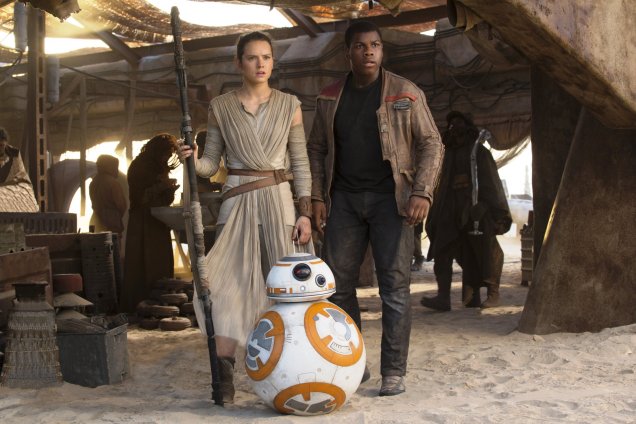
Image description: Two characters, Rey (a young White woman) and Finn (a young Black man), stand adjacent to each other under a tent on a desert planet called Jakku. They are looking off screen at approaching danger. Accompanying them is BB-8, a small white and orange droid shaped like a ball.
As I mentioned in a previous post, I am a huge Star Wars fan. I saw The Force Awakens on its first night (i.e. the Thursday night preview) right after my 7:30 to 10 pm class. It was the last day of the semester, but the class still ran till 10 pm! Didn’t my professor know Star Wars was coming out???
Spoilers for The Force Awakens below! If you haven’t seen the film and don’t want to know what happens, don’t read any further!
Overall, I enjoyed the movie, but I remember leaving and feeling like something was off about it. I’m not just talking in regard to its racial and gender politics, but also in terms of how you can really feel George Lucas’ absence. I know a lot of people will say that’s a good thing, but Lucas’ political commentary, especially in the prequels and the Clone Wars animated series, is something I’ve enjoyed and appreciated over the years (despite all of the problematic elements in those films/shows). I thought The Force Awakens was weak on the political and spiritual themes (aside from the obvious Nazi reference and Maz having a generic line about the Force). A common criticism of the film is that it was a rehash of A New Hope, which I can definitely see. I think this is, again, where we see Lucas’ absence because, as he told Charlie Rose in a recent interview, Disney wanted to go “retro” with The Force Awakens. Lucas, on the other hand, wanted to take it in a new direction.
However, I think something that is overlooked in this criticism of The Force Awakens is that it is the most diverse Star Wars film yet. Yes, there were Black men characters like Lando Calrissian and Mace Windu, and White women characters like Leia Organa and Padme Amidala, but The Force Awakens is the first time where we see the story centered on a White woman and a Black man. It’s also the first time we see a Latino male actor (Oscar Isaac) playing a supporting role in Star Wars. As readers on my blog know, I am very critical of movies, but I admit, when I first saw the movie, it was refreshing and pretty awesome to see a cast that wasn’t the usual all-white male ensemble. I definitely enjoyed this about the film, but like anything, it’s not perfect.
There are already some great critiques written about the way the film depicts Finn (John Boyega) and chooses to make Lupita Nyong’o a motion capture CGI character instead of having her appear in the movie. I’ll get to these critiques later in the post, but below are some of my thoughts about the way many blog posts, message boards, and fan sites are talking about Rey and Finn. As much as I liked most of the casting decisions, I expressed in my previous post that I was worried that White people would use The Force Awakens to argue that we live in a “post-racial” and “post-gender” society where racism, sexism, and other forms of oppression “don’t exist anymore.”
What’s problematic about the way fans/columnists/bloggers talk about Rey and Finn is that they either (1) erase Rey’s Whiteness and refer to her as just “a woman” (because we’ve been conditioned to think White women represent the “default” woman, therefore there’s no need to specify Rey is White), or (2) describe Finn as being Black, but fail to mention he’s also a man (because when we hear the term “Black character,” we assume that the “default” Black character is a Black man, therefore no need to specify Finn is a man), or (3) both of the above. What I’ve also noticed is (4) the erasure of Finn’s Blackness in certain conversations where he’s just referred to as a “male character” or just “a guy.” This is often done when Finn is discussed in relation to Rey and when the gender politics of the film are the only focus, as if race doesn’t matter or play a role.
For example, I’ll see people write, “The Force Awakens is so inclusive! The film has a Black lead and a female lead!” But why are people specifying Finn’s racial background, but not specifying Rey’s racial background, yet focusing on her gender? I’ve also read articles that praise the film for portraying “a male character” (Finn) who constantly “needs saving from a woman.” I definitely advocate challenging the prevalent “damsel in distress” trope where women need to be saved by men, but Finn is not just a male character and Rey is not just a woman. This is important because when we talk about Rey as a White woman, it complicates the racial and gender politics of the film. Because it’s not just Finn, a Black man, being saved “by a woman,” but rather by a White woman.
This is where I think the film gets problematic because Finn is not only frequently rescued by White characters (Rey and Han Solo), but he also, as Andre Seewood asserts, “lacks dramatic agency.” Unlike Rey, he cannot communicate with Wookies or droids nor does he know how to fly spaceships, despite being a trained stormtrooper and cleared for battle. The film later reveals that Finn worked in sanitation, which I found really stereotypical, but why would he be cleared for his first battle on Jakku if he wasn’t trained for combat? The argument can be made that Finn is Force sensitive (which I believe he is), but the end result is that he’s knocked unconscious quite brutally by the White antagonist, Kylo Ren (Adam Driver). Having a Black male character being constantly rescued by White characters reinforces the message that Black people need to be led/guided/saved by White people. Recognizing Rey’s Whiteness makes us think about the power dynamics. Is it sexist when women are portrayed as always needing to be saved by men? Yes, but we cannot just look at gender and ignore race, or vice versa. Rey is still White and we see her Whiteness reinforced in opposition to Finn through the way she has more dramatic agency.
I do like both Rey and Finn, don’t get me wrong (and Daisy Ridley and John Boyega delivered fantastic performances), but it is problematic when people fail to understand how race and gender intersect. In describing a screenshot for a Star Wars pinball table, an article on Kotaku states: “Here’s Rey instructing Finn to get his timid butt to cover while a real hero handles things.” This ridiculing of Finn and characterizing him as “timid” (or, as I’ve heard some people say, “a bumbling coward”) is something I’ve seen mostly from White commentators/fans. Yes, apparently it’s the White woman who needs to “instruct” the Black man on how a “real hero handles things.” Neither Rey nor Finn come from privileged backgrounds, but we know that White women can still oppress men of color. The author of the article may not have been thinking, “Rey is superior than Finn because she is White,” but the pattern in which White characters (whether men or women) are treated or perceived as more competent, skilled, and heroic than Black and other people of color characters is one that has existed for a long time. I don’t think Rey is portrayed as oppressing Finn, but the depiction of a White woman constantly saving a Black man reinforces a White savior narrative.
For the record, I don’t see Finn’s character as a “bumbling coward” nor do I think he is completely stereotypical. Finn standing up against the First Order and refusing to kill for them is heroic and hardly a “cowardly” thing to do. I read this act of resistance as being anti-establishment, especially when one considers how the First Order rose from the ashes of the Galactic Empire. For those who don’t recall the Star Wars prequels, the Galactic Empire rose to power through votes, i.e. through the democratic process, not because of a military coup or external force. Lucas has stated in the commentary track for Revenge of the Sith that he wanted to portray how a democracy becomes a dictatorship, not from an outside force, but by being handed over from the inside (“This is how liberty dies. With thunderous applause”). Revenge of the Sith featured heavy political themes and commentary about the Bush administration (the “you’re either with me or you’re my enemy” line being the most obvious), but it also attempted to shift people’s understanding of Palpatine’s Empire. Although Lucas expressed that the original trilogy was meant to protest the U.S. war against Vietnam, the Empire was mostly seen by audiences as far removed from the U.S. Say what you want about the prequels, but the politics of those films were meant to reflect and critique U.S. government corruption and imperialism. The formation of the Galactic Empire served as an analog for U.S. Empire. Through this lens, Finn resisting an Order that rose from the Empire can be read as resisting U.S. Empire, but I’m not going to pretend for a second that this is the message Disney is trying to promote! The foundations for a compelling and relevant narrative of a Black man rebelling against a predominately White imperialist Order (one that orders mass murder against villagers and obliterates entire planets) are there, but this narrative is not explored.
As much as I root for Finn, I notice that the more I watch the film (I’ve seen it four times… so far…), the more annoyed I become at how the narrative treats him. In many ways, it felt like his character was treated as serving the White protagonists. I thought Abrams and co-writer Lawrence Kasdan did a disservice to Finn’s character during his fight scene with the stormtrooper (who is equipped with a lightsaber-deflecting stun baton). When Finn used Luke’s lightsaber and fought against the very people that stole him from his family and attempted to brainwash him with their imperialist ideology, that was his moment. The sequence ended with Finn battling the stormtrooper and being knocked to the ground, only to be saved at the last second by Han Solo. Finn should have defeated that stormtrooper. Again, that was his moment. One of the basic rules of screenwriting is that you want your protagonist(s) to get out of situations on their own (there are exceptions, of course). If you have a movie where your character is stranded on an island and you solve it by having a random plane arrive out of nowhere and saving the day, that’s obviously very contrived and convenient. Granted, Han Solo was there on the battlefield, so it’s justified and not exactly deus ex machina, but it did not need to be written that way. Given how Finn turned his back on the First Order, overcoming and defeating that stormtrooper would have been so much more symbolic. In my opinion, having Han blast the stormtrooper from a distance took that moment away from Finn.
I’m not saying I think Finn should have been portrayed as a typical hyper-masculine character. I’m just saying that when you watch scenes like him getting zapped by BB-8, strangled by Chewbacca, almost eaten by a Rathar, almost killed by that stormtrooper, and almost beaten to death by Kylo Ren, I think erasing his Blackness becomes problematic because we know how Black bodies are often brutalized by police brutality (being assaulted, tazed, choked, shot at, and murdered). When Rey is suspicious about Finn and assumes he is a thief upon their first meeting, it’s hard not to draw parallels with how close that is to reality. I get people argue their points within the context of the story (i.e. it takes place in a galaxy far, far away), but the film is still released here on Earth and we need to understand the impact of these images within our sociocultural and political contexts. I don’t think it’s helpful for people to go “colorblind” on these issues (or go “colorblind” anywhere, really).
But perhaps the most important reason why all of this matters is because failing to identify Rey as a White woman and just referring to her as “a woman,” and failing to specify Finn’s gender and just referring to him as a “Black character” contributes to further marginalizing and erasing women of color. If Rey was Black, for example, I doubt promotional material would refer to her as simply a “woman lead,” they would say, “a Black woman lead.” Again, it’s because when we say “she is a woman lead,” we assume that “woman” means “White woman.” I remember being disappointed when I first heard about Lupita Nyong’o playing a motion capture character. It’s yet another example of people of color, especially Black women, being otherized as aliens or non-human characters in science fiction/fantasy films and TV shows. We saw this before with Zoe Saldana playing a motion capture CGI character in Avatar, as well as having her skin colored green in Guardians of the Galaxy. As Seewood writes, the primary reason why Nyong’o was hidden as a CG character is because the filmmakers did not want the “talents of a Black actress who happens to be of Mexican and Kenyan descent to distract and diminish the White heroine Rey (Daisy Ridley) whom they had chosen to be the true hero of this installment of the tale.” Seewood cites Joseph Boston who writes:
“The casting of largely unknown Daisy Ridley as a central protagonist in the ‘Force Awakens’ therefore entrusting an inexperienced actress with a multi-billion dollar corporation while Oscar winner Lupita Nyong’o is relegated to a supporting CGI character named Maz Kanata is but the latest example of “Star Wars” and Hollywood’s misogynoir & its ‘problem’ with Black women writ large.”
It has been said many times before that leading roles for Black women and other women of color in Hollywood films are extremely limited. The Star Wars films are no exception (read my previous post for more on the few women of color characters in the Star Wars universe). During a press conference, J.J. Abrams mentioned that someone asked him why he cast “someone as beautiful as Lupita Nyong’o to play a motion-capture character?” Abrams’ response was, “Would it be ok if she were ugly?” The problem is that the wrong question was asked. What should have been asked is, “Why are you hiding a Black actress behind a motion-capture character when there are not any Black women or women of color characters in the film?” There have also been rumors that Abrams was not satisfied with her performance and decided to delete many of her scenes. Whether this is true, the reality is that Nyong’o, unlike Andy Serkis, does not specialize in playing CGI characters, so what was the purpose in having her playing a motion capture character? Why not have her play a human character?
Had Rey been Black (can you imagine that, a Star Wars film with both a Black woman and Black man in lead roles), I think the conversation about the racial and gender dynamics in the film would be much different. I remember when Mad Max: Fury Road was released, there were many critiques about the lack of people of color in the film. As much as I enjoyed it, I was still annoyed at how the two women of color in the film were relegated to limited roles or killed off so quickly. One blogger wrote in a very nuanced post, “If Furiosa had been black or brown, I feel like the reactions would have been very different. It would have not been hailed as the second coming of feminist films.” I feel the same holds true for Rey if she was played by a Black or Brown actress. In next year’s Star Wars spin-off film, Rogue One, we see another diverse cast, which includes Pakistani-British actor Rizwan Ahmed, but once again, we don’t see any women of color characters. For Episode 8, I heard rumors about Gugu Mbatha-Raw possibly being cast, but then I read an article saying she didn’t get the role? It would be really disappointing if the latter is true.
Hopefully, in Episode 8 and future films, we’ll see improvements, not just in terms of casting and diversity, but in how characters of color are portrayed. One can hope, right?



 Muslim Reverie